Diagnose the problem
Pinpoint what is getting in the way: weak pressure, unclear motivation, missing escalation, unresolved threads, structural drift or something else.

Story-development software for fiction writers when a story stalls. Bring an idea, an outline or your manuscript.
A way forward
Bring an idea, an outline or your manuscript. StuckWriter helps you examine the story and decide what to develop next.
Pinpoint what is getting in the way: weak pressure, unclear motivation, missing escalation, unresolved threads, structural drift or something else.
Explore endings and directions that grow naturally from your existing characters, themes, conflicts and ideas.
Work backwards from the destination to identify the scenes, clues, developments and turning points that can carry the story there.
See it in action
In our sample story, Mara wants to rescue her brother and expose the truth. The diagnosis identifies where those aims need to collide.
“The ferry departure is an action, but the draft has not yet defined the choice it will force.”
That gives the writer something concrete to work on: a choice that makes the ending matter.
Follow the story through the demo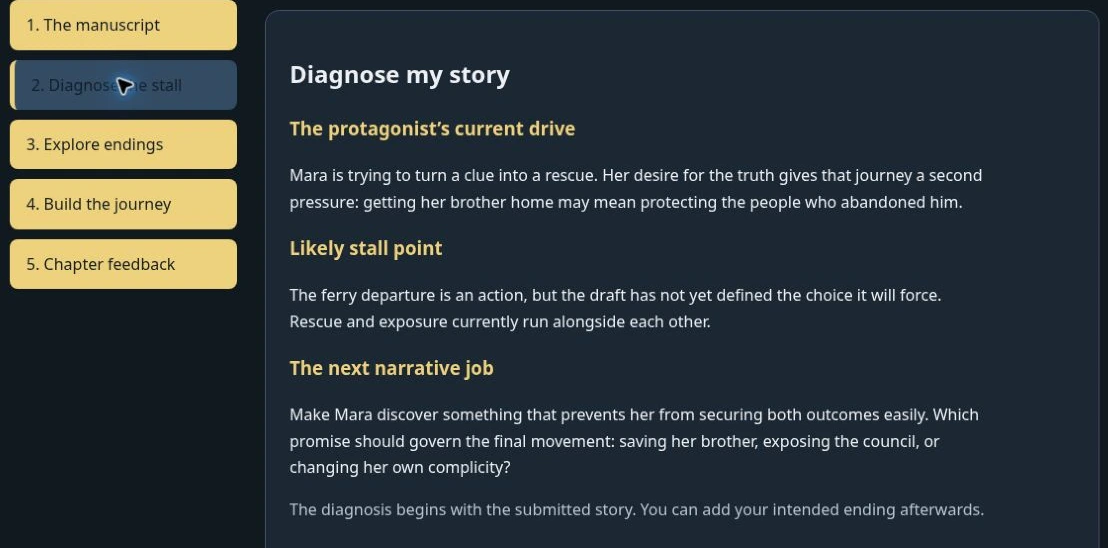
The tools
Explore your story as a whole, work through a sticking point or examine a chapter closely. Choose the help you need.
Select a feature to read more.
A focused diagnosis of what may be weakening the story and where your attention is likely to be most useful.
Develop your existing ideas, test alternatives and see more clearly what each choice could lead to.
Turn an intended destination into the stepping stones that can make the journey feel convincing and earned.
Step back and review structure, scenes, characters and narrative threads when you need to see the story as a whole.
See what each scene or chapter needs. Get focused feedback alongside your manuscript on character motivation, tension, pacing and continuity, with specific suggestions grounded in the text you wrote. See what is working, where readers may need more clarity, and what you could strengthen—then decide which changes serve your story.
An actual creator example
In The Night of the Mosquito, StuckWriter suggested clarifying the chain of custody around independent DNA testing to strengthen the scene’s credibility.
A real example from StuckWriter’s creator
From The Night of the Mosquito by Max China, novelist and StuckWriter’s creator. During a job interview at a secret psychiatric facility, George Kotlas reveals that he arranged independent DNA testing on a patient.
The feedback below was produced from the full scene. This short extract shows part of the exchange it examined. The scene contains references to violence and forensic evidence.
‘They went along with that at Ashmore?’ Rubenstein seemed incredulous. ‘For that to work, you’d have needed a sample from the Ripper.’
‘There is genetic material,’ Kotlas said. ‘It was recently recovered from historic samples found at the scene of one of the murders.’
‘I heard about that, but honestly, that semen could have come from anyone.’
‘That’s what they said at Ashmore, but I wanted to take it further if only to get Wolfe to see that what he was experiencing had no basis in fact.’
‘Did they relent?’
‘No. I took some of Wolfe’s hair. It wasn’t hard; he consented. I sent it for independent testing.’
Copse Hall. 8:31 a.m. George Kotlas turned into the visitor’s car park and pulled up close to the reception building. He looked around as he opened the back door and unhooked his suit jacket from the holder above the window. The tarmac and white lining were obviously new. Only one other car was parked there. A mixture of excitement and anticipation fluttered in his stomach. He recalled the letter Dr Rubenstein had sent three weeks ago. It had contained a brief introduction, together with an invitation to call him, but it was the title – Director of Forensic Psychiatry, Proof and Experimental Unit – that drew Kotlas in. ‘Dr Rubenstein? It’s George Kotlas. You wrote to me—’
‘Dr Kotlas.’ Rubenstein cleared his throat. ‘Yes, I did. I take it you’re interested?’
‘At this stage, I’d say I’m more curious. Why approach me?’
‘Haven’t you heard, Kotlas? There’s an acute shortage of psychiatrists per se. And practitioners with your provenance are rarer still. I sent a non-disclosure form with the letter. Sign and return it to me. Until then, I’m not at liberty to discuss anything further.’ Kotlas complied. A flurry of correspondence followed; a formal interview was arranged and confirmed in writing, along with a list of procedures to be followed on his arrival at the hospital. It occurred to him that Sunday was an odd day to ask him to come in, but it was his day off. It suited him. He still didn’t know exactly what his new role, if successful, would entail. He patted his pocket to check his passport hadn’t fallen out, locked the car, and then followed the directional signs for Reception. Once Kotlas had completed his security induction, he sat examining his knuckles, comparing one hand to the other. When he’d finished that, he turned to his palms. Unsurprisingly, the calluses on his right were harder and thicker than those on his left. The security guard who had recorded his fingertip biometrics had remarked on them. ‘Are you sure you’re a doctor? Your hands look like you lay bricks in your spare time.’ Kotlas had grinned. ‘I do a lot of work with my hands.’ The door in front of him opened. A bespectacled middle-aged man stepped through and locked it behind him. ‘Dr Kotlas, I presume?’ He closed the space between them with surprising speed and held out his hand. ‘I’m Dr Rubenstein. Philip, but we use last names around here. Welcome. I’m sorry about the delay. Control Room protocol, I’m afraid. Come on through.’ He unlocked the door again. ‘I’ll escort you up to my office.’ Rubenstein used his keys to open and close the numerous doors that barred their way. Finally, he led the younger man into a long passage around the corner. ‘I’ve lost my bearings,’ Kotlas said and paused in the middle of the corridor. ‘Is this new? It’s just that I noticed a large, older building close behind where Reception would be.’
‘Keep moving, Kotlas.’ Rubenstein glanced at the CCTV monitors projecting from the ceiling. ‘You’ll make security nervous. To answer your question, it’s a blend of new construction and the adaptation of the existing. This institution is the first of its kind in the country. Aside from those who work here, few are aware of its existence. Copse Hall is a private enterprise, located on a vast country estate, well away from prying eyes. Here, we hope to gain greater insight into the minds of some of the worst former juvenile killers in the world. What goes on here is not for discussion beyond these walls,’ Rubenstein said. ‘You know, I’m envious of you, Kotlas. At your age, the possibilities of being on the cutting edge, the opportunities that will present themselves.’
‘We’ll see.’ Kotlas nodded thoughtfully. ‘Very quiet, isn’t it?’
‘We have just a few patients for now, and the staffing levels are commensurate with that. I’ll explain further when we get to my office. Right. Here we are.’ Rubenstein stopped by a passenger lift. He placed his fingertips on the reader control, and the steel sleeves of the doors slid open. They stepped inside. The doors automatically closed, and they began to ascend. Rubenstein unlocked his office door and ushered Kotlas through. ‘There’s another reason for the facility appearing quiet. We’ve sent ten guards out to collect our star patient, from Ashmore.’
‘Ashmore? That’s where I work,’ Kotlas said. ‘I must confess, it’s part of why I approached you.’
‘So, not so much about shortage, more about provenance.’ Kotlas’ eyes narrowed. ‘Ten-man security detail? Not many warrant that. I think I know the answer to my next question. What’s his name?’ Rubenstein indicated the vacant chair. ‘Take a seat,’ he said, walking around his desk. ‘First things first. I already know a lot about you. Let’s fill in the blanks.’
‘No. Wait. How can you have arranged to do that without me knowing?’ Kotlas shook his head. Rubenstein peered over the top of his spectacles. ‘Patience, dear boy. We’ll come back to that in a few moments.’ Ten minutes later, Rubenstein pushed away from the desk and walked to the window. He turned and, leaning against the window board, faced Kotlas. ‘Look, as far as I’m concerned, based on what we’ve discussed, the job’s yours.’ Kotlas smiled. ‘That’s great, but you haven’t explained exactly what my role is if I accept. Or how you managed to find out so much about me. You said this is a private company?’ Rubenstein rubbed his lower lip with a forefinger. ‘Yes, I did.’
‘So, tell me, who leaked the information?’ Rubenstein strode back to his seat, sat down, propped his elbows on the desk, and clasped his hands together. ‘I want you to continue your work with Wolfe.’ Kotlas leaned back in his chair. ‘And the leak?’
‘There’s no leak. All this may seem presumptuous, but if you accept, you’re cleared to begin working with us right away.’ Kotlas pulled on the lobe of his left ear. ‘Forgive me. I just have to be sure of a few things..’
‘I told you, this establishment is top-secret. We’re in partnership with the government. It’s an arm’s-length arrangement.’
‘In case things go wrong,’ Kotlas said, tight-lipped. ‘And if I don’t accept?’
‘Someone else will. But you are our preferred option. What do you say?’
‘I get to continue working with Wolfe?’
‘Under my stewardship, yes.’ Rubenstein paused. ‘Do you accept?’ Kotlas reached for a sheet of paper. ‘Can I?’
‘Of course.’ Rubenstein watched, puzzled, as Kotlas took a pen from his inside pocket and scribbled a list of notes. He pushed the paper across the desk. ‘Subject to these terms.’ The older man took the sheet and read. ‘I can live with those things. We’ll get a contract drawn up. Now, tell me what you know about the man.’
‘I’m sure you know most of this already, but this is my resume. Wolfe weighed in at twenty-three pounds when he was born.’ Rubenstein raised his eyebrows. ‘You didn’t know that?’
‘Of course I did, but hearing of such an abnormality never fails to stagger me,’ the older man said. ‘Carry on.’
‘I think it’s obvious he was delivered by Caesarean section. His parents were both six-footers, but neither side of the family had had a child that big before. Destined for greatness, some might say, but he was never going to have a normal life. He outgrew his parents by the time he was nine years old. He claims he first killed when he was ten, but there’s nothing to substantiate that. By the age of thirteen, he was uncontrollable. Killed two girls that year, and despite a massive police hunt, went on to kill five more before they caught him. Bad, isn’t it? The savagery of the killings shocked even hardened detectives. The method used was pretty much the same in each case. They all had something in common: He ate bits of them. Took different parts from each. Trying different things on the menu, he said. As you’re aware, he’s been in the system ever since.’
‘You’ve worked with him for the last two years. How do you see him? Mad or bad?’
‘What do you think?’
‘Kotlas, I’m asking you,’ Rubenstein said. ‘He’s had dozens of psychiatric assessments, and not one of them agrees. To me, he’s both. He sees himself as a victim of his genes.’
‘He does? That one is news to me,’ Rubenstein said. ‘Elaborate.’
‘Wolfe,’ Kotlas said softly. ‘What’s in a name, eh? It comes from his mother’s side. As you probably know, he adopted it when his father died.’
‘Yes, I found that strange. You’d have thought he’d want to keep his father’s name alive.’
‘Maybe. You also know he claims a psychic link to Jack the Ripper?’
‘That wasn’t taken seriously.’ Rubenstein, perhaps sensing a change in tack, viewed Kotlas with suspicion. ‘Why do you bring it up?’
‘Wolfe became more difficult to deal with, complaining that no one listened to him. He went berserk during a routine transfer. Bit one of the staff. He almost overpowered eight burly nurses, all of them highly trained. He ended up in seclusion for a long time. It took me ages to get through to him again.’ Kotlas moistened his lips. ‘Can I have a glass of water?’
‘Over there,’ Rubenstein pointed at the water cooler. ‘Help yourself.’ The young candidate got to his feet, continuing to speak as he approached the machine. ‘I told him there was only one way to prove what he was saying was true.’ He filled a clear plastic cup and took a sip. ‘Submit to a DNA test.’
‘They went along with that at Ashmore?’ Rubenstein seemed incredulous. ‘For that to work, you’d have needed a sample from the Ripper.’
‘There is genetic material,’ Kotlas said. ‘It was recently recovered from historic samples found at the scene of one of the murders.’
‘I heard about that, but honestly, that semen could have come from anyone.’
‘That’s what they said at Ashmore, but I wanted to take it further if only to get Wolfe to see that what he was experiencing had no basis in fact.’
‘Did they relent?’
‘No. I took some of Wolfe’s hair. It wasn’t hard; he consented. I sent it for independent testing.’
‘I’m going to stop you there, Kotlas. What you did is in contravention—’
‘Hear me out, Rubenstein,’ he said harshly. The older man reddened, unaccustomed to being addressed in such a manner. ‘I’m sorry. But guess what? It was a match. He’s related. Now, you can argue till you’re blue in the face that it may not be the Ripper’s DNA, but even if it isn’t, what are the odds of Wolfe’s sample coming up positive? Answer me that. And what is even more bizarre, I read somewhere that the Ripper had a taste for blood, and that certain body parts were missing from his victims. The official line from those days was that he’d taken them as trophies, but I now believe he ate them. Maybe blood-thirst runs in the genes, and if we accept that, it could be where Wolfe gets it from.’ Rubenstein stared, measuring the younger man. ‘It seems you’re not above a little experimentation yourself, Kotlas.’ He stood abruptly and strode around the desk, offering his hand. ‘Welcome aboard.’
These are suggestions to assess against the manuscript. For example, the full scene already mentions a Caesarean delivery. The writer can decide whether that gives readers enough context for Wolfe’s extraordinary birth weight, or whether another detail would help. Accept, adapt or leave a suggestion according to what your story needs.
Try before you buy
Follow a sample story through diagnosis, possible endings, the journey and chapter feedback. A read-only tour with prepared examples.
Take the guided tourGet a free sample of focused feedback, once per verified email address. No card required and no automatic subscription.
Try a chapterSeparate from your subscription allowance. How we handle your writing
Story understanding and development.
The same tools and allowances from your first month, with optional one-off top-ups when you need more.
Every month
£6.99
Story analysis and development help.
Payments renew automatically until cancelled.
Cancel anytime. Access continues until the end of your paid month.
Uses the number of manuscript or planning words you submit. Unused words roll over.
Fresh help diagnosing a stall, exploring endings or building the journey.
Buy 10,000 words of focused scene or chapter feedback for £5.99. A separate word balance.
Unused whole-story and detailed-analysis words roll over in separate balances. The 3 monthly development requests reset at renewal. Reading saved feedback uses no allowance.
Each month adds 40,000 whole-story analysis words and renews your allowance of 3 development requests. Detailed scene/chapter analysis words are purchased separately. Unused words remain in their separate balances while subscribed.
Use some words as you write or save them for a completed draft.
Unused whole-story and detailed-analysis words carry forward. Monthly development requests reset at renewal; purchased development extras remain available. Word balances are preserved during a subscription break, but no new monthly allowance is added while inactive.
Use whole-story analysis to examine the characters, structure and story threads in either an unfinished or completed manuscript. Detailed chapter analysis is an optional deeper pass: review selected chapters during development, or the whole manuscript when you are ready for revision or a pre-release appraisal.
StuckWriter saves its story understanding for the development tools to reuse. Opening saved analyses and feedback uses no allowance. Asking for fresh development help uses a development request, even when the manuscript reading is reused.
A fresh whole-story analysis uses the submitted word count again. A 25,000-word manuscript uses 25,000 of your 40,000 whole-story words, leaving 15,000 for later. Updating My Story Ideas can reuse saved manuscript readings, using one development request. A fresh detailed pass uses the scene or chapter word count from your separate detailed-analysis balance.
Choose additional allowance when you need it. Top-ups are separate one-off purchases; they do not increase your monthly subscription price. You review the price before paying.
| You buy | One-off price |
|---|---|
| 40,000 whole-story analysis words + 3 development requests | £6.99 |
| 10,000 detailed scene/chapter analysis words | £5.99 |
Purchased words left over from a detailed pass stay in your balance while subscribed. For example, analysing 4,000 words from a 10,000-word pack leaves 6,000 for later. Purchased development requests are retained separately from your monthly allowance. Packs do not extend subscription access.
Adding or editing ideas, importing or reading your manuscript, saving, syncing and downloading your work uses no analysis or development allowance. Allowances belong to your account and can be used across your projects.
Cancellation stops your next renewal. You keep access and remaining allowances until the end of your paid month. After access expires, unused whole-story and detailed-analysis word balances are preserved for when you resubscribe to the same account. No new monthly allowances accrue while inactive.
To manage or cancel in PayPal, sign in with the PayPal account you used to subscribe to StuckWriter.
Review and approve your recurring payment in PayPal.
More author tools from the StuckWriter family
Author Business Manager helps you keep track of books, deadlines, ISBNs, royalties and unfinished material. A practical addition to your writer resources, with a complete companion handbook inside.
Manage tasks and promotions, record monthly royalties, keep research and character notes, and attach photos or documents. Your business records stay on your own device.
£14.99 introductory one-time purchase
Both PC editions included. No subscription or ChatGPT account required.
David Wiseman’s practical guide to managing your writing career, with a foreword by Max China. Read it inside the business manager and apply its routines to the way you work.
The iPhone/iPad edition is now available separately through the Apple App Store. The Windows PC editions are sold separately through stuckwriter.com.
Read about the handbookYes. You can start with your first idea, a synopsis, an outline or a few chapters. You do not need a finished book or previous publishing experience. StuckWriter also helps experienced writers examine unfinished and completed manuscripts.
No. It helps you analyse and develop your own story. The choices — and the writing — remain yours.
Yes. StuckWriter can work with a partially written manuscript, a synopsis or an outline. The more story material you provide, the more context it has when helping you understand the story and explore what comes next.
No. Detailed scene and chapter analysis is optional. Try selected chapters while developing your story; we recommend a full detailed pass once the draft is complete. Whole-story analysis and development help can be used without running a detailed pass.
£6.99 per month includes 40,000 whole-story analysis words and 3 development requests. Unused story-analysis words roll over. Detailed scene/chapter analysis is an optional extra: 10,000 words for £5.99. Saved feedback is free to reread.
Your subscription costs £6.99 per month and renews automatically until cancelled. Existing subscribers retain their original pricing and allowances.
Yes. You can begin with a single idea, character, situation, scene fragment or possibility and develop it directly in StuckWriter. You do not need a manuscript before you start.
Yes. StuckWriter can help you work backwards from the destination and identify the developments, turning points and stepping stones that could make the journey towards it convincing and earned.
No. StuckWriter works with novels, novellas and short stories, as well as earlier-stage material such as synopses and outlines.
Yes. Author Business Manager brings together the business records around your books. StuckScreenwriter is planned for screenwriters who find themselves stuck, and Planster is being developed for pantsers who realise they need a plan. They form part of the StuckWriter family.
Yes. Use your whole-story word balance to analyse a completed manuscript. The request must fit your available balance and the 100,000-word technical limit. You can accumulate unused words or buy additional words. Detailed chapter feedback uses a separate balance.
Yes. Your ideas do not need to be in order. Add fragments, possible scenes, characters, what-if thoughts, alternative directions or half-formed ideas and continue developing them as the story evolves.
Fixed is for things you currently want included in the story. Ideas is for possibilities you are still exploring. Both remain editable, so they can change as your story develops.
Yes. Your project is saved as you work, including where you are in the development process, so you can return and continue from where you left off.
Yes. Signed-in projects can be synchronised between devices. Allow synchronisation to finish before moving to another device, and avoid editing the same project on two devices at the same time.
Cancellation stops your next renewal. You can use StuckWriter and your remaining allowances until the end of your paid month. After access expires, unused whole-story and detailed-analysis word balances are preserved for when you resubscribe to the same account. No new monthly allowances accrue while your subscription is inactive.
Yes. Where StuckWriter produces substantial analysis or development material, you can download the text to keep and work with alongside your manuscript.
You can wait for your next monthly allowance or purchase additional analysis, development requests or detailed-analysis words. Saved results can be reread without using allowance. Prices are shown in the Pricing section.
Unused whole-story and detailed-analysis words carry forward. Monthly development requests reset at renewal; purchased development extras remain available. Word balances are preserved during a subscription break, but no new monthly allowance is added while inactive.
By the length of the scenes or chapters you ask StuckWriter to analyse. A chapter of 2,000 words uses 2,000 words of allowance. Requesting a fresh detailed analysis counts those words again; reading its saved feedback uses nothing.
Why StuckWriter exists
You can know your characters, love the premise and see parts of the ending, yet still reach a point where the next move refuses to come. StuckWriter was created for that moment.
“Developing and using StuckWriter has helped me get past the sticking points in my manuscripts—and inspired ideas for several new stories.”
Find your way forward
Take a closer look at what StuckWriter can do for yours.
Explore the free demoContact
Email: [email protected].
Max China is the trading name of Brian Maczka.
StuckWriter business address:
121 Vardon Drive, Southend-on-Sea, SS9 3SH, United Kingdom.
For account, subscription or technical support, include the email address used for your StuckWriter account and a brief description of the problem. Please do not send passwords or payment-card details by email.